
 Ultimate guide
FASD Informed Parenting Strategies 2026: A Guide
Last Updated: October 25, 2026
Quick Summary
FASD informed parenting adapts the caregiving environment to how a child's brain actually works, rather than asking the child to meet expectations their neurology cannot support. It reduces demands on memory, impulse control and cause-and-effect reasoning, and builds external structure around them through shorter instructions, visual cues and fewer words during stress.
- Standard parenting advice fails with FASD because it targets behavior instead of the processing differences underneath it.
- During a meltdown, reduce input first: turn off the television, lower your voice and give physical space.
- Use a two-step countdown with a five-minute warning, then a one-minute warning, delivered with a visual timer.
- Consequences for FASD need to be immediate, short and connected to the behavior to register.
- Escalating consequences when the first one doesn't work usually backfires and increases shame and meltdowns.
Table of Contents
- What FASD Informed Parenting Strategies Mean in 2026
- FASD Meltdown Strategies That Calm the Storm
- Building FASD Visual Schedules and Routines That Stick
- FASD Transition Strategies for Everyday Changes
- FASD Parenting Scripts for Caregivers Under Pressure
- Discipline That Fits the FASD Brain
- Where to Find FASD-Informed Support and Tools
- Frequently Asked Questions
What FASD Informed Parenting Strategies Mean in 2026
FASD informed parenting is an approach that adapts the caregiving environment to how a child's brain actually works, rather than asking the child to meet expectations their neurology cannot support. At Harrison's Hope, we see this shift change households: the same child, the same parent, a different outcome. The old playbook, built on consequences and consistency-as-punishment, assumes a brain that learns from cause and effect the way neurotypical children do. FASD-informed strategies assume the opposite and build from there. That single reframe is what separates a home that runs on constant correction from one that runs on predictability and calm. Below, we break down what these strategies look like in daily life and where most families get stuck.
Why Typical Parenting Advice Falls Short
Standard parenting advice fails with FASD because it targets behavior instead of the processing differences underneath it. A child who cannot yet connect a consequence to an action three hours later is not being defiant; the bridge between the two is missing. When parents respond to the behavior with firmer consequences, the loop tightens and meltdowns increase. The real issue is a mismatch between expectations and brain function.
For a deeper look at why conventional approaches backfire, read our guide on why traditional parenting fails FASD.
The Brain-Based Difference
Brain-based parenting starts with a simple question: what does this child need to succeed right now? FASD affects memory, impulse control, and cause-and-effect reasoning, so the strategy is to reduce demands on the functions that are hardest and build external structure around them. Shorter instructions. Visual cues. Fewer words during stress. The difference shows up fast in the home: fewer battles over the same tasks, and a caregiver who stops feeling like a referee.
FASD Meltdown Strategies That Calm the Storm
The most effective FASD meltdown strategies lower stimulation and reduce language, not raise them. A meltdown is a nervous system overload, not a discipline problem, and the goal in the moment is safety and de-escalation, not teaching a lesson. That distinction changes everything about how you respond.
What to Do in the First Five Minutes
Reduce input first. Turn off the television, lower your voice, and give physical space. Speak in short, concrete phrases: "You're safe. I'm here." Avoid asking questions or demanding explanations, because the reasoning part of the brain is offline during overload. Offer a sensory anchor, like a weighted blanket or a quiet room, and wait.
If the meltdown happens in public, our guide to managing FASD meltdowns in public spaces walks through the same first-five-minutes playbook for store aisles, school parking lots, and family gatherings.
What to Avoid During a Meltdown
- Raising your voice to be heard over the child
- Asking "why did you do that?" mid-meltdown
- Threatening consequences that won't happen
- Crowding the child or making direct eye contact if it escalates
- Trying to reason through the situation in the moment
The article's first-five-minutes playbook for a meltdown breaks down into a few simple moves.
| Action | What to do |
|---|---|
| Reduce input | Turn off the television, lower your voice, give physical space |
| Keep language short | Use concrete phrases like "You're safe. I'm here." |
| Skip questions | Avoid asking questions or demanding explanations |
| Offer a sensory anchor | Weighted blanket or a quiet room, then wait |
Building FASD Visual Schedules and Routines That Stick
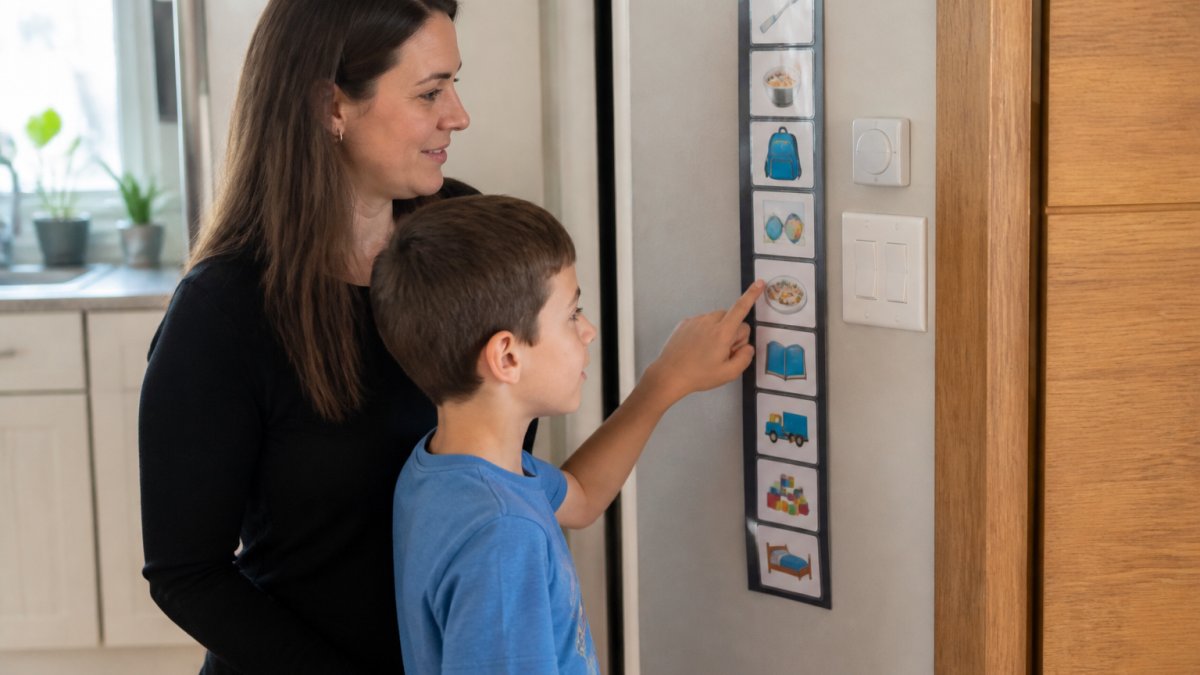
Visual schedules work for FASD because they move expectations out of a child's unreliable working memory and onto the wall where they can be seen. A schedule that sticks is simple, consistent, and reviewed every morning, not a laminated poster that gets ignored by week two.
Choosing the Right Visual Tools
Match the tool to the child's age and reading level. Picture cards suit younger children; a written checklist with checkboxes suits teens. Keep each step to one action, and post the schedule at eye level in the room where the routine happens. Review it together before transitions, not after a problem starts. Consistent visual scaffolding remains equally vital when supporting children with ADHD, as structured prompts help bridge the gap between intention and action for neurodivergent learners.
FASD Transition Strategies for Everyday Changes
Transitions are hard because switching tasks demands cognitive flexibility, one of the areas FASD affects most. The fix is to make the change predictable and give the brain time to prepare, rather than springing it on a child mid-activity.
Transition Warnings and Countdowns
Use a two-step countdown: a five-minute warning, then a one-minute warning, delivered with a visual timer the child can see. Name the next activity specifically ("in one minute we put on shoes for the bus") rather than a vague "time to go." Keep the wording identical each time so the pattern becomes familiar.
FASD Parenting Scripts for Caregivers Under Pressure
Scripts help because they take the thinking out of a heated moment. When you're tired and the child is escalating, having a rehearsed line ready keeps your response steady and predictable, which is exactly what an FASD brain needs.
Sample Scripts for Common Flashpoints
- Refusal to get ready: "Shoes on now. Then we go. I'll help with the left one."
- Hitting a sibling: "Hands down. You're safe. We'll talk when your body is calm."
- Store meltdown: "We're leaving now. I've got you. Walk with me."
- Homework shutdown: "One problem. Just this one. Then a break."
Discipline That Fits the FASD Brain
Discipline for FASD means teaching and repairing, not punishing. Consequences still exist, but they need to be immediate, short, and connected to the behavior, because delayed or abstract consequences don't register. A child who loses screen time "for the week" learns nothing; a child who loses it for the rest of the evening can connect the dots.
For practical at-home behavior strategies that align with this approach, see our guide on managing FASD behaviors at home.
A common mistake is treating every incident as a teachable moment. Some days the win is simply getting through the routine without a crisis.
Watch out: escalating consequences when the first one doesn't work usually backfires, because the child isn't refusing to comply, they're unable to. Piling on punishment increases shame and meltdowns without teaching the missing skill.
Where to Find FASD-Informed Support and Tools
You don't have to build this alone. FASD-informed support gives caregivers a place to compare notes, borrow strategies that already work, and stop reinventing the wheel at 9 p.m. Peer groups are often where parents first hear a strategy that fits their exact child.
Our guide to finding peer support for FASD caregivers covers where to look and what to ask. You can also explore our FASD resource library for recommended books, websites, and support materials for families, educators, and professionals.
Harrison's Hope offers caregiver- and lived-experience-informed support, from practical tools to advocacy training, built by a disability-led team that understands FASD from the inside. If you're early in the journey or years in, the tools are designed to meet you where you are.
Frequently Asked Questions
What does FASD-informed parenting mean?
FASD-informed parenting means adjusting your approach to how a child's brain actually works rather than expecting them to meet typical developmental milestones. It replaces punishment-based discipline with predictable routines, visual supports, and calm responses to dysregulation. The focus shifts from correcting behavior to understanding the cause behind it, which reduces conflict at home and helps children feel safe enough to learn new skills over time.
How can I help a child with FASD manage emotional dysregulation?
Start by identifying the triggers that precede dysregulation, such as hunger, noise, or unexpected changes. Build a predictable daily rhythm with visual schedules so the child knows what comes next. When emotions rise, lower your voice, reduce stimulation, and give space rather than reasoning in the moment. FASD informed parenting strategies work best when practiced during calm periods so the child recognizes the routine when stress hits.
What should I do during an FASD-related meltdown?
Keep the environment safe and quiet, speak in short calm phrases, and avoid arguing or asking questions that require reasoning. FASD meltdown strategies focus on co-regulation: your calm presence does more than any consequence. After the meltdown passes, offer a drink, a snack, or quiet time before discussing what happened. Many caregivers find that a brief debrief hours later, when the child is regulated, is more effective than talking it through immediately.
How can I create routines that work for a child with FASD?
Use FASD visual schedules and routines that show each step with pictures or simple words, posted where the child can see them. Keep the sequence consistent and rehearse it during calm moments. Break tasks into single steps rather than giving multi-part instructions. Review the schedule together each morning and adjust visuals as the child grows. Predictability reduces anxiety and gives the child a sense of control over their day.
What discipline strategies are effective for children with FASD?
Consequences work best when they are immediate, brief, and connected to the behavior. Long-term punishments or removal of privileges days later rarely land because the connection to the original action is lost. FASD informed parenting favors natural consequences, calm redirection, and teaching replacement behaviors. Focus on what you want the child to do next rather than dwelling on what went wrong, and keep your responses consistent so the child can predict them.
Where can families find practical FASD caregiver tools and support?
Look for organizations led by people with lived experience who offer workshops, one-on-one consultation, and caregiver peer groups. Harrison's Hope is a registered Canadian charity providing FASD-informed support across the lifespan, from prevention education to senior care. Their team combines professional expertise with lived experience, and their caregiver groups give families a place to feel understood. Contact them directly to ask about services and any financial support options available.
The gap between a home that runs on constant correction and one that runs on predictability is usually a handful of strategies applied consistently. Harrison's Hope exists to put those strategies in caregivers' hands, with practical FASD-informed tools, advocacy training, and a community that understands the daily reality. Get started with Harrison's Hope and build a calmer, more stable home for your family.