 Ultimate guide
Inclusive Engagement Strategies for Organizations: A Guide
Quick Summary
Inclusive engagement is the practice of designing how an organization invites, involves and listens to people so that those usually left out can take part on equal terms. It treats participation as a design problem, moving the work to the organization by finding who is missing and removing the logistical and trust barriers that keep them away.
- An open door is not enough; the organization must adjust format, location, language and follow-up.
- Start outreach through trusted intermediaries, since a personal call often beats a flyer.
- Map your community with the data you hold, then talk to local service providers about who is missing.
- Remove barriers such as venue access, plain-language materials, mixed scheduling, cost support and phone-in options.
- Close the feedback loop by telling participants what you heard, decided and did not change.
Table of Contents
- What Inclusive Engagement Means for Canadian Organizations
- Building Trust and a Welcoming Atmosphere Before the First Meeting
- Mapping Your Community and Reaching Hard-to-Reach Groups
- Removing Barriers: Accessible Venues, Formats, Scheduling and Digital Participation
- Community Engagement Tools for Planning, Outreach and Feedback
- Building a Community Engagement Plan Template You Can Reuse
- Measuring Outcomes, Closing the Feedback Loop and Choosing Your First Inclusive Engagement Step
- Frequently Asked Questions
What Inclusive Engagement Means for Canadian Organizations
Last Updated: November 15, 2026
Inclusive engagement is the practice of designing how an organization invites, involves and listens to people so that those who are usually left out can take part on equal terms.
Inclusive engagement is not the same as having an open door. An open door still asks people to walk through it on their own terms, with their own resources, time and confidence. Inclusive engagement moves the work to the organization: it asks who has been missing, adjusts the format, the location and the language, and follows up.
Canadian organizations have a useful starting point. The accessibility framework is already set out in federal and provincial law, and organizations should confirm the current requirements that apply to them (About an Accessible Canada). Compliance is the floor, not the goal.
Caregivers of children with FASD often describe feeling judged before they have said a word, and families who have been let down by one service are reluctant to try another. An engagement approach that works for them has to start with trust.
Building Trust and a Welcoming Atmosphere Before the First Meeting
Trust usually decides whether someone attends a second time, and it is often settled before the first meeting begins. Readers can learn about Harrison's Hope, our story, mission and team to see who is behind the work.
Start with plain language. Invitations that use jargon or assume prior knowledge filter people out before they arrive. Describe what will happen, how long it will take, who will be there and what it will cost, which is nothing if that is the case.
Relationships matter more than announcements. A common mistake is to rely on a single email or a poster and then wonder why no one came.
Be explicit about what participants can expect from you. Tell them whether they will be recorded, how their information will be used and whether they can leave at any time. Honour those commitments at the first meeting.
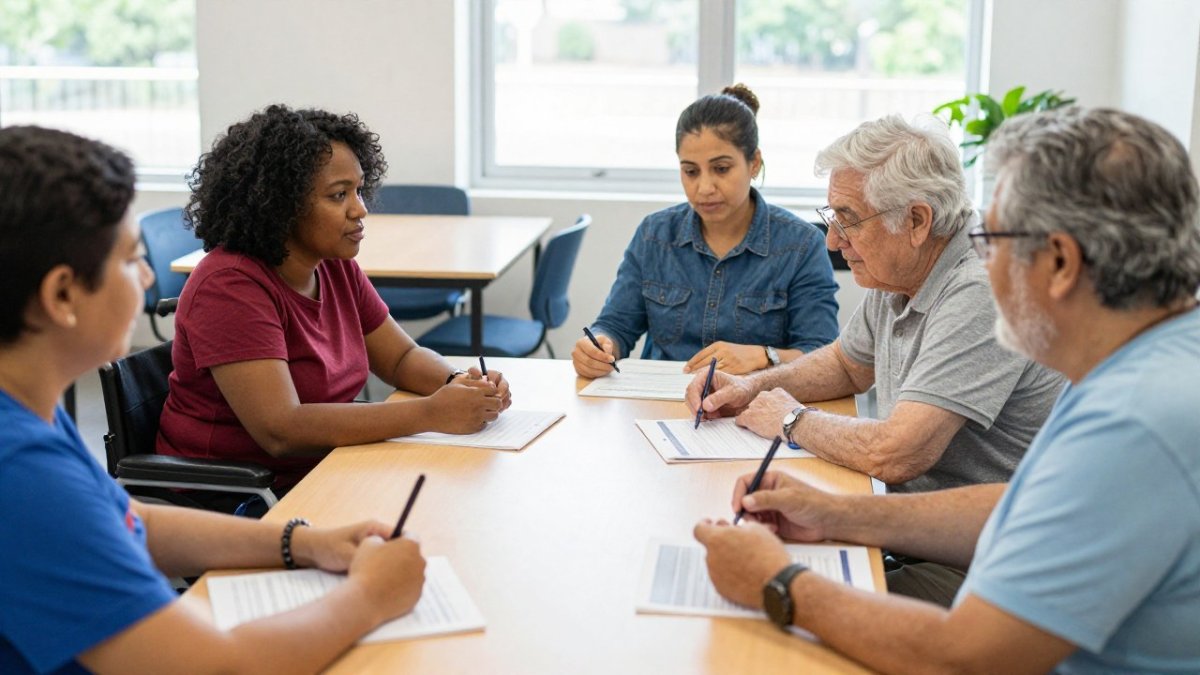
When you do meet, arrange the room so it feels shared rather than presented. Round tables, name tags in a clear format and a visible offer of refreshments change the tone.
Mapping Your Community and Reaching Hard-to-Reach Groups
You cannot include people you have not identified. Community mapping is the process of finding out who lives, works and gathers in the area you serve, and which of those groups your current engagement does not reach.
Next, talk to people. Local service providers, community associations, Indigenous organizations where relevant, newcomer settlement agencies and school staff all hold knowledge that census tables do not capture. Ask them which groups face the greatest barriers, what those barriers are and what has worked for them in the past.
Hard-to-reach groups often share certain features: they may distrust formal institutions, work shifts that clash with daytime meetings, lack reliable transport or speak a language other than English or French as their first language. Their absence is rarely a lack of need.
Translate your mapping into a short list of priority groups and the channels that reach them. For each group, note who to contact, where they already gather and what would make attending worthwhile.
Removing Barriers: Accessible Venues, Formats, Scheduling and Digital Participation
Barriers are practical as well as attitudinal, and each one removed widens the group who can take part. Start with the venue. Check step-free entry, accessible washrooms, seating that allows wheelchair users to sit beside companions, and sufficient space between chairs.
Formats matter as much as places. Provide materials in large print, plain language and, where useful, audio or video with captions. Offer sign language interpretation or assistive listening devices when you can arrange them.
Scheduling decides who can attend at all. Evening sessions may exclude shift workers and parents of young children, while weekday mornings may exclude people who work. Offer a mix of times, and ask participants which options suit them rather than assuming.
Digital participation extends your reach but can also create new exclusions. Not everyone has reliable internet, a suitable device or the comfort to join a video call. Offer a phone-in option, a plain-text alternative to video and a way to request help setting up.
The article points to several practical barriers that can be removed, each widening who can take part.
| Barrier | Example fix | Why it matters |
|---|---|---|
| Venue access | Step-free entry, accessible washrooms | Lets wheelchair users attend |
| Sensory overload | Quiet space to step out to | Keeps people with sensitivities in the session |
| Format | Large print, plain language, captions | Makes materials usable |
| Scheduling | Mix of day and evening times | Includes shift workers and parents |
| Cost | Transit or childcare coverage | Removes financial barriers |
| Digital access | Phone-in option, plain-text alternative | Reaches people without reliable internet |
Community Engagement Tools for Planning, Outreach and Feedback
The right tools make inclusive engagement easier to run and easier to review. They do not replace the relationship work described above, but they help you keep track of it.
For planning, a shared project tracker lets a small team assign outreach tasks, record which groups have been contacted and note follow-up dates. A simple spreadsheet works well if it has columns for the group, the contact person, the channel, the date of last contact and the next step.
For outreach, a contact management tool helps you record conversations with partner organizations and individual participants, with appropriate consent and privacy practices. Keep only the information you need, store it securely and check that your handling of personal data meets the requirements of Canadian privacy law, including the Personal Information Protection and Electronic Documents Act where it applies and any provincial equivalent (PIPEDA fair information principles).
For feedback, short surveys, a comment board at the venue and a follow-up phone call each capture different things. Surveys reach more people but tend to get fewer detailed answers. Phone calls take more time but surface concerns people would not write down.
Whatever tools you choose, test them with a small group first. A survey that takes fifteen minutes to complete will lose people halfway, and a planning tracker that only one staff member understands will fall apart when that person leaves.
Building a Community Engagement Plan Template You Can Reuse
A written plan turns good intentions into a schedule. The template below is a starting point you can adapt to any program or initiative.
Community Engagement Plan
1. Purpose: What decision or program this engagement will inform. Example: "Shape the schedule of our caregiver support group."
2. Priority groups: List the groups you are prioritizing and why. Example: "Foster parents in the north part of our service area, who have told us they cannot attend weekday evenings."
3. Outreach channels: For each group, name the channel and the contact person. Example: "Foster agency coordinator, email and phone, first contact by [date]."
4. Accessibility plan: Venue, format, scheduling, cost support and digital options. Example: "Step-free venue with quiet room; large-print handouts; Saturday morning and Tuesday evening sessions; transit reimbursement; phone-in option."
5. Participation method: How people will take part and what they will contribute.
Keep the plan to two or three pages. A plan no one reads is no use, so share it with the people it affects and invite comments before you finalize it.
Measuring Outcomes, Closing the Feedback Loop and Choosing Your First Inclusive Engagement Step
Most organizations measure attendance and stop there. Attendance tells you who came, not whether the engagement was inclusive or whether it changed anything.
Closing the feedback loop is the step most organizations skip. Within a set period after an engagement, tell participants what you heard, what you decided and why, and what you did not change. Honest explanation of constraints builds more trust than silence.
Be realistic about what to do first. You do not need a full plan, a dedicated budget and a perfect map before you begin. Pick one group you are not reaching, one barrier you can remove this month and one way to tell participants what happened to their input. Run that small step, review what you learned and build from there.
Harrison's Hope works with organizations and families to put these approaches into practice, from caregiver programs and peer support to training and advocacy. If your organization is ready to make its engagement more inclusive, Harrison's Hope's services and supports can help you plan a first step, and the team's accessibility statement explains the standards we follow and how to report a barrier.
Frequently Asked Questions
What does inclusive engagement mean for an organization?
Inclusive engagement means designing outreach, meetings and decisions so that people who are usually left out, including people with disabilities, Indigenous community members, newcomers and families raising children with FASD, can take part on equal terms. It goes beyond sending an invitation. An organization practising it asks who is missing from the room, removes practical barriers such as cost, transport, timing and communication format, and treats community input as a real influence on decisions. For a charity like Harrison's Hope, this often means co-designing workshops with the families who will attend.
How can organizations make community engagement more inclusive?
Start by mapping who lives in or relies on your community, then ask those groups how they prefer to be reached. Offer multiple participation channels such as in-person sessions, phone calls and online meetings, and provide plain-language materials and interpretation where needed. Pay attention to scheduling around work and caregiving, and consider offering childcare or transport support. Build relationships through trusted local partners before asking for input, because people are more likely to participate when they already know who is asking.
How can organizations reach people who are often left out of engagement?
Work through the community organizations, faith groups, schools and peer networks that already have trust with these groups, rather than relying only on public notices or a website post. Test outreach messages with a few community members before launching. Offer flexible participation options, such as short surveys, drop-in sessions or one-to-one conversations, so people can contribute in the way that fits their situation. Track who responds and adjust your approach when certain groups stay absent.
How should organizations make engagement activities accessible?
Check physical accessibility of the venue, including entrances, washrooms and seating, and consider whether the space is calm enough for participants who are sensitive to noise or crowds. For communication, use plain language, large print, captions and accessible digital documents. Offer a range of formats and allow participants to request accommodations in advance. Rick Hansen Foundation accessibility certification and built environment audits are one way Canadian organizations can verify their spaces against recognized standards.
How can organizations build trust with communities they serve?
Trust grows through consistent, respectful contact over time. Be clear about what you are asking for, what you can realistically change, and what will happen with the input you receive. Show up to community events without a sales agenda, listen before proposing solutions, and share how past feedback shaped decisions. Including people with lived experience on planning teams signals that their perspectives carry weight and makes it easier for others to engage.
How can organizations measure the success of inclusive engagement?
Measure both participation and influence. Participation indicators include the range of groups represented, attendance and retention across sessions, and the share of participants who came through new outreach channels. Influence indicators look at whether community input changed a decision, program or policy, and whether participants were told what happened. Ask participants directly how safe, welcome and understood they felt, and review the results with community members before setting the next year's priorities.
Do inclusive engagement efforts need a budget for participant support?
Yes, and budgeting for it early prevents exclusion. Costs can include transport, childcare, interpretation, meals, accessible materials and honoraria for people with lived experience who contribute their time. The exact amount depends on your activity, number of participants and location, so build a line item for each cost and request current quotes from suppliers.