 Ultimate guide
Rick Hansen Accessibility Certification Process: 2026 Guide
Table of Contents
- What the Rick Hansen Accessibility Certification Process Actually Involves
- RHFAC Certification Levels and How the Rating System Scores Buildings
- The RHFAC Building Assessment Process, Step by Step
- RHFAC Certification Cost and Budgeting for Building Owners
- How to Become an RHFAC Professional: Training, Exam, and Designation
- Preparing Your Building for Assessment and What Happens After
- How RHFAC Certification Compares to Legal Accessibility Requirements
- Conclusion: Turning an Accessibility Rating Into Meaningful Access
- Frequently Asked Questions
Last Updated: October 16, 2026
What the Rick Hansen Accessibility Certification Process Actually Involves
The Rick Hansen Accessibility Certification process is a third-party building assessment that scores how usable a space is for people with disabilities, then awards a recognized rating based on that score.
That distinction trips up a lot of people. The same program name covers two different things, and mixing them up wastes time and money.
Certification applies to a building. Qualification applies to a person. A building earns a rating after an assessment. A professional earns a designation after training and an exam.
The Rick Hansen Foundation administers the program under its Rick Hansen Foundation Accessibility Certification program framework, and the ratings it issues are used by owners, tenants, and funders as a practical measure of how well a space supports meaningful access.
Certification for Buildings vs. Qualification for Professionals
Building certification is an assessment outcome. A trained assessor evaluates a property against a defined set of accessibility criteria and issues a rating.
Professional qualification is a credential held by an individual. It requires completing a training course, passing an exam, and meeting the program's eligibility requirements.
| Track | Who It Applies To | What It Requires | What You Get |
|---|---|---|---|
| Building certification | Property owners and operators | A site assessment by a qualified professional | A published accessibility rating |
| Professional qualification | Individuals pursuing assessment work | Training course, exam, designation | A recognized credential |
Most owner inquiries are about the first track. Most career inquiries are about the second.
RHFAC Certification Levels and How the Rating System Scores Buildings
The rating system produces a score, and that score maps to a certification level. Higher scores reflect more comprehensive accessibility across the building's features, from barrier-free access at entrances through to inclusive design in washrooms, wayfinding, and public spaces.
The assessment is holistic rather than pass-fail. A building is evaluated across many accessibility criteria, and the final rating reflects overall accessibility performance rather than a single checkbox.
What most summaries miss is that a mid-range rating is not a failure. It is a roadmap. The scoring breakdown tells an owner exactly which features cost them points, which is far more useful than a simple yes-or-no verdict.
The RHFAC Building Assessment Process, Step by Step
The assessment follows a defined sequence.
- Register the property with the program and confirm eligibility for the building type.
- Engage a qualified professional to conduct the site assessment.
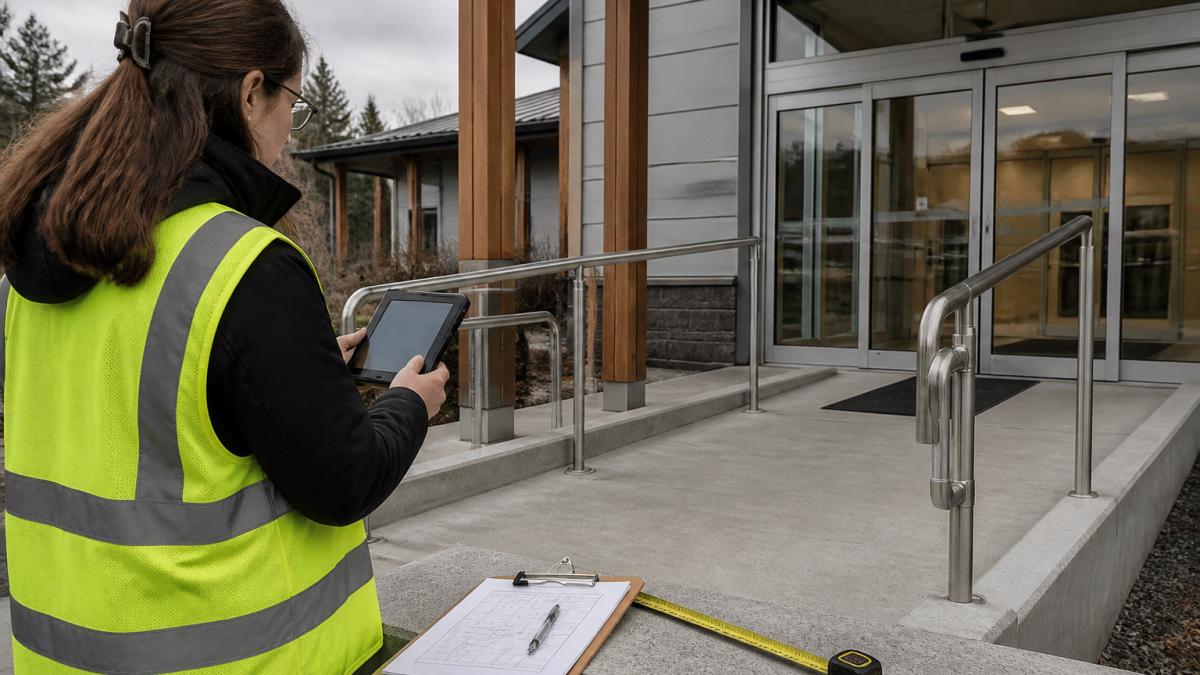
- Complete the site assessment, where the assessor reviews building features against the accessibility criteria.
- Receive the rating outcome, including the score and the certification level awarded.
- Review the findings and identify accessibility improvements.
- Plan improvements and recertify when ready to improve the score.
How Long Certification Takes From Registration to Rating
Timelines vary by building size, complexity, and assessor availability, so we avoid quoting a fixed number. A single small facility moves faster than a multi-building portfolio. The practical constraint is usually scheduling the site assessment and compiling documentation, not the assessment itself.
Owners who gather drawings, prior audit reports, and maintenance records before the assessor arrives tend to move through the process faster. Our advice: start the paperwork the day you register.
RHFAC Certification Cost and Budgeting for Building Owners
Most owners arrive at this section looking for a number.
Four cost pools matter, and they behave very differently:
- Program and registration fees. These are set by the Rick Hansen Foundation and scale with the size and complexity of the property. A single small commercial building sits at the low end; a multi-building portfolio or a large institutional campus sits well above it. Confirm current fees directly with the program before you commit, because published rates change.
- Assessor fees. Independent qualified professionals set their own rates. Expect the fee to reflect travel, building square footage, the number of distinct spaces assessed, and how much documentation you supply. An assessor who has to reconstruct drawings from scratch charges for that time.
- Remediation and improvement costs. This is the line that dwarfs everything else. The assessment itself is a rounding error next to the capital work a low rating can surface, entrance regrading, door hardware, washroom retrofits, signage replacement, wayfinding systems. A single barrier-free entrance rebuild can exceed the entire assessment cost several times over.
A common pattern we see: owners approve the assessment fee without a remediation reserve, then stall for a year when the report lands.
Two more budgeting realities worth planning around.
If you are comparing certification against doing nothing, frame it correctly: the cost of certification is the assessment plus the improvements you choose to make.
How to Become an RHFAC Professional: Training, Exam, and Designation
Becoming an RHFAC Professional means completing the program's training and passing its exam. The training is delivered through an online course designed for self-paced learning, which suits working professionals in architecture, engineering, construction, and accessibility consulting.
The path looks like this:
- Meet the program's eligibility and qualification requirements
- Complete the training course, typically over a set course duration
- Pass the exam
The course covers accessibility standards, rating criteria, and how to conduct a site assessment. For people already working in the built environment, the training formalizes knowledge they partly hold already.
Preparing Your Building for Assessment and What Happens After
Preparation is the part of the process owners control completely, and it is also where the most preventable delays happen.
Before the assessment: the document and site checklist
- Confirm the building type is eligible for certification under the current program criteria
- Collect as-built drawings, floor plans, and site plans, including any recent renovations
- Gather maintenance records for doors, elevators, lifts, and automatic operators
What happens after the rating lands
The report is not the end of the process. It is the input to a remediation plan, and the owners who get value treat it that way. A workable sequence:
- Triage the findings. Sort every item into quick wins (maintenance-level fixes), mid-term work (contractor involvement, no design changes), and capital projects (design, permits, procurement). Most reports contain far more quick wins than owners expect.
- Score the trade-offs. Ask which findings affect the most criteria, which affect the most building users, and which unlock other improvements. A door-width fix that also resolves a wayfinding problem is worth more than either alone.
- Assign owners and dates. Findings without a named person and a target date do not get done. Put the triage list into your existing capital planning cycle rather than running it as a side project.
- Track progress against the criteria. Keep the report's scoring breakdown as your tracker. Each completed item should map back to the criteria it improves, so you can see the rating trajectory before the next assessment.
- Plan recertification deliberately. Ratings are time-limited. Schedule the reassessment far enough out that completed improvements are visible in the new score, and far enough in that you are not paying for a second assessment before the first round of work is finished.
The most common post-assessment failure is treating the report as a compliance document to file rather than a capital plan to execute. Owners who do that pay for an assessment and get nothing back except a number.
Recertification and continuous improvement
Recertification is not a repeat of the first assessment. It is a chance to demonstrate movement.
For owners managing multiple properties, stagger the assessment and recertification cycles across the portfolio. That spreads the cost, keeps internal assessment expertise sharp, and avoids the situation where every building comes due in the same fiscal year.
How RHFAC Certification Compares to Legal Accessibility Requirements
Certification is voluntary. Legal accessibility requirements are not. That is the core difference, and it matters for how owners plan.
Provincial human rights legislation and building codes set the minimum legal standard for accessibility in the built environment. Meeting that standard keeps a building compliant.
The two are not in conflict. A building that meets its legal obligations can still score poorly on a holistic assessment, because legal minimums and meaningful access are not the same thing.
For organizations that want to go beyond compliance, our team at Harrison's Hope supports Accessibility for Ontarians with Disabilities Act requirements aligned work through accessibility consulting, co-design support, and built environment audits, including Rick Hansen Accessibility Certification audits.
Conclusion: Turning an Accessibility Rating Into Meaningful Access
A rating is only useful if it changes something. The owners who get real value from the Rick Hansen Accessibility Certification process are the ones who treat the score as a starting point, budget for the improvements it identifies, and recertify as the building improves.
If your organization is working toward meaningful access and inclusion, Harrison's Hope can help. We offer accessibility consulting, co-design support, inclusive engagement, Rick Hansen Accessibility Certification audits, and built environment audits, all grounded in the lived experience of people with disabilities.
Frequently Asked Questions
How much does it cost to get Rick Hansen certified?
RHFAC certification cost depends on building size, complexity, and whether you pursue certification or certification plus. The Rick Hansen Foundation publishes current fees on its website, and pricing is typically quoted per project rather than as a flat rate. Budget for the assessment fee plus any accessibility improvements identified during the site visit. Building owners should request a formal quote before committing, since costs vary widely between a small retail space and a multi-story commercial facility. Harrison's Hope can help organizations understand what the process involves before they budget.
What are the Rick Hansen Accessibility Guidelines?
The Rick Hansen Foundation Accessibility Certification program uses a rating system built around measurable accessibility criteria covering the built environment. These include barrier-free access routes, door widths, washroom design, signage, parking, and inclusive design features that go beyond minimum building code. Each criterion is scored during a site assessment by a trained RHFAC Professional. The resulting accessibility rating reflects how well a building performs across physical access, public spaces, and facilities. The guidelines are designed to give building owners practical guidance on where to improve.
How long does the Rick Hansen Foundation Accessibility Certification process take?
Timelines vary by building size and readiness. A typical certification process includes registration, scheduling a site assessment, the assessment itself, and a review period before the rating outcome is issued. Small buildings may complete the process in a few months, while larger or more complex facilities can take longer, especially if accessibility improvements are needed before certification. Building owners should plan for the assessment and any remediation work as separate phases when setting their project timeline.
What is the difference between RHFAC training and RHFAC certification?
RHFAC training qualifies an individual to conduct building assessments, while RHFAC certification applies to a building. Training involves an online course, self-paced learning modules, and an exam that leads to the RHFAC Professional designation. Certification is the rating a building receives after a designated professional completes a site assessment. Understanding this distinction matters for building owners, because hiring a trained accessibility professional is a separate step from certifying the property itself.
Can an existing building receive Rick Hansen Foundation Accessibility Certification?
Yes. Existing buildings can pursue certification, and many owners use the process to identify accessibility improvements rather than to confirm an already-accessible facility. The assessment evaluates the building as it stands, and the rating outcome shows where barriers exist and what changes would raise the score. Post-assessment improvements and recertification are options if you want to improve your rating over time. This makes the program useful for older buildings that were designed before current accessibility standards were in place.
How do you become a certified accessibility professional?
Becoming an RHFAC Professional starts with enrolling in the foundation training course, which covers accessibility criteria, assessment methods, and the rating system. The course is delivered online and is self-paced, so participants can work around existing commitments. After completing the training, candidates write an exam. Passing the exam and meeting any eligibility requirements grants the designation. Trained professionals can then conduct building assessments and support organizations through the certification process, including documentation and post-assessment guidance.
Disclaimer: This article is for general information only and does not constitute legal advice. Accessibility requirements vary by province, territory, and building type. Confirm current obligations with the appropriate authority before acting.