 Comparison
Brain-Based Parenting Training Review for Caregivers
Last Updated: November 3, 2026
Quick Summary
Brain-based parenting training teaches caregivers how a child's developing brain responds to stress, connection, and routines, and how adult responses can calm or escalate that system. Evidence is real but uneven, so ask providers what outcome data includes families like yours, especially for FASD.
- Five options dominate the landscape and differ more in format, time commitment, and caregiver fit than in science.
- The Hughes and Baylin book is the cheapest way to test the ideas before a facilitated program.
- Most studies rely on parent report, and few trials follow families beyond a year.
- FASD-informed practice means fewer verbal instructions, more visual ones, and predictable routines.
- Most providers do not publish prices, so ask directly about fees and subsidies.
Table of Contents
- What Brain-Based Parenting Training Teaches Caregivers
- Program Comparison: Features, Format, and Fit
- What the Brain-Based Parenting Evidence Actually Shows
- FASD-Informed Parenting Strategies in Practice
- Attachment-Focused Parenting Strategies for Daily Life
- Caregiver Training for FASD: Costs, Access, and Time Commitment
- Choosing Support That Fits Your Family's Next Step
- Frequently Asked Questions
What Brain-Based Parenting Training Teaches Caregivers
Brain-based parenting training teaches caregivers how a child's developing brain responds to stress, connection, and daily routines, and how adult responses can either calm or escalate that system. This review examines what these programs actually cover, where the evidence is strong, and where caregivers should look closely before committing time and money.
The core idea is simple: many traditional parenting approaches assume a child can reason through consequences. For a deeper explanation of why traditional parenting fails kids with FASD, see our neuro-informed guide. Brain-based approaches start somewhere else, with the nervous system.
How the Neuroscience of Caregiving Shapes the Curriculum
Most programs build their curriculum around a handful of connected ideas from neuroscience and interpersonal neurobiology. Caregivers learn how stress hormones affect behavior, why a dysregulated child cannot access reasoning in the moment, and how repeated calm responses build resilience over time.
The stronger curricula pair this theory with practice. Expect modules on reading escalation cues, co-regulation, and repairing after conflict. The weaker ones stop at explanation and leave caregivers without a script for Tuesday night.
Attachment and Emotional Regulation as Core Outcomes
Two outcomes sit at the center of nearly every credible program: healthy attachment and emotional regulation. Attachment-focused parenting strategies aim to build a child's sense of safety with the caregiver. Regulation work teaches both people to return to calm after stress.
What most guides miss is that these two goals depend on the adult's state first. A caregiver in threat mode cannot offer attunement, no matter how well they know the theory. Good training addresses the adult's regulation before the child's. When a caregiver can meet a child's distress with steadiness, creative expression can become another way to support connection, as the art therapy guide suggests.
Program Comparison: Features, Format, and Fit
Five options dominate the current landscape, and they differ far more in format, time commitment, and caregiver fit than in underlying science. The table below compares them on what we can verify from published program information, and it flags where the public record is silent so you know what to ask before you enroll.
| Program | Format | Core Focus | Best For | Time Commitment | Pricing |
|---|---|---|---|---|---|
| Harrison's Hope | Workshops, peer support, one-on-one consultation | FASD-informed caregiving, advocacy, lived experience | Families raising children with FASD | Recurring sessions; varies by stream | Not published; contact for details |
| Brain-Based Parenting (Hughes & Baylin) | Book | Neuroscience of caregiving and attachment | Caregivers who want the theory first | Several evenings over weeks | Book retail price |
| Brain Based Parenting Academy | Online academy | Re-examining parental patterns | Parents seeking self-reflection | Self-paced modules | Not listed |
| Incredible Years Parent Programs | Structured group programs | Social and emotional development | Early-intervention parenting | Weekly sessions across multiple months | Not listed |
| Brain Based Parenting podcast | Weekly audio | General parenting topics | Low-commitment listening | About an hour per week | Free |
Harrison's Hope is a disability-led organization built around lived experience, not just clinical theory. Its services span prevention education to senior care.
The Hughes and Baylin book remains the best entry point for the neuroscience itself. It combines an attachment specialist's perspective with a clinical psychologist's grounding in neurobiology.
Incredible Years offers the most formal group structure of the set.
Caregiver-specific fit is the column most comparison tables skip. Foster and kinship caregivers usually need training that fits agency schedules and documentation requirements, and adoptive caregivers often need content on trauma histories and pre-verbal neglect.
Best for: Harrison's Hope suits families who need FASD-specific, ongoing support. Skip if: you want a self-paced course with a published price list.
Best for: the Hughes and Baylin book suits readers who want the science before the strategies. Skip if: you need peer support and coaching alongside the content.
What the Brain-Based Parenting Evidence Actually Shows
Here is where we part company with the marketing. Brain-based parenting evidence is real but uneven, and the gap between what programs claim and what research supports is wider than most brochures admit. The most useful question is not "is there evidence?" but "what kind, measured how, over what period, and in whom?"
Evidence Quality and Limitations
The strongest evidence sits behind structured, manualized group programs evaluated in controlled studies, typically measuring parent-reported behavior changes over months. The weakest sits behind general "neuroscience-informed" branding, where the brain science is accurate but the training itself has never been tested. A curriculum can cite real neurobiology and still have no outcome data of its own.
Several limitations deserve attention:
- Most studies measure parent report, not independent observation, so a caregiver who feels calmer may report improvement even when a blinded observer sees none
- Few trials follow families beyond a year, so sustained improvements remain uncertain
- Samples rarely isolate FASD, meaning findings may not transfer to prenatal alcohol exposure
- Facilitator qualifications vary widely, and a well-designed curriculum delivered poorly is not the intervention the study tested
That third point is the one caregivers should weigh most. A program can be well-evidenced for the general population and still be a poor fit for a child whose brain development followed a different path. This is not a reason to skip training. It is a reason to ask providers what they know about FASD specifically, and whether any of their outcome data includes families like yours.
How Outcomes Are Measured
When a program claims it improves adaptability, orientation, or caregiver sensitivity, ask what instrument produced that claim. Common tools in this field include caregiver self-report questionnaires, structured observation of parent-child interaction, and child behavior checklists completed by a caregiver or teacher.
A realistic expectation is a shift in the caregiver's own responses and confidence, not a transformation of the child's neurology. Programs that promise the latter are overreaching. Programs that promise the former, and can show you how they check it, are being honest about what training can do.
A common mistake is treating any citation of "neuroplasticity" as proof of effectiveness. Plasticity is real; it does not tell you whether a given curriculum changes anything.
Watch out: accepting a single positive study as settled science. One trial with a small sample and no long-term follow-up is a promising signal, not a guarantee, and it says nothing about whether the program will work for a child with a trauma history or an FASD.
FASD-Informed Parenting Strategies in Practice
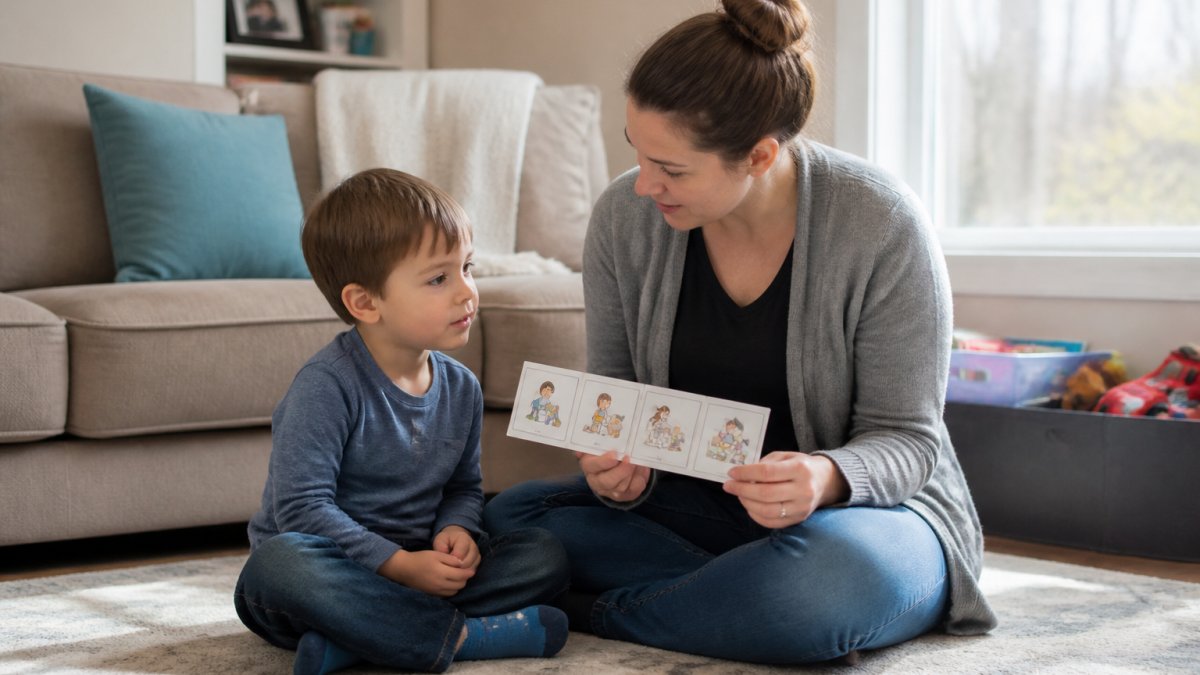
FASD-informed parenting strategies translate brain science into specific accommodations. The throughline is external support for functions the child's brain does not reliably handle alone.
In practice, that means fewer verbal instructions and more visual ones. It means predictable routines, shorter transitions, and calm repetition instead of lectures. It means separating the behavior from the child's intent, because intent and outcome often diverge with FASD.
Watch out: removing all structure in the name of flexibility backfires. Children with FASD typically need more scaffolding, not less, and predictability is the scaffolding.
The practical test of any training is whether it changes what you do at 7 a.m. on a school day. If a program leaves you with theory but no routine, it has not finished the job.
Attachment-Focused Parenting Strategies for Daily Life
Attachment-focused parenting strategies work best as small, repeatable moves rather than grand gestures. Caregiver sensitivity and responsiveness matter more than perfect technique.
Start with these:
- Name the emotion before correcting the behavior
- Lower your voice and slow your speech during escalation
- Offer proximity before demands
- Repair quickly after a rupture, without a lecture
- Protect predictable connection points, such as bedtime
Attunement is the skill underneath all five. For concrete day-to-day strategies, see managing FASD behaviors at home. It means reading the child's state accurately and responding to that state rather than to your own frustration.
Caregiver Training for FASD: Costs, Access, and Time Commitment
Caregiver training for FASD varies widely in cost and access, and most providers do not publish prices. Expect to ask directly about fees, subsidies, and whether sessions run online.
Time commitment is the more honest filter. A book takes evenings over several weeks. A structured group program typically runs weekly sessions across multiple months. Peer support groups ask for a recurring hour. None of these is trivial for a working caregiver.
Access questions worth asking before you enroll:
- Is the program delivered online, in person, or both?
- Are sessions recorded for caregivers who miss one?
- Is there financial assistance for families?
- Does the facilitator have direct FASD experience?
Foster and kinship caregivers face an extra layer, since training often needs to fit agency schedules and documentation requirements. Our FASD-informed foster parent training guide covers options tailored to these constraints.
Choosing Support That Fits Your Family's Next Step
Choosing well comes down to fit, not reputation. The best program is the one you will actually complete and apply.
Use this checklist:
- Does the provider name FASD explicitly, or only "trauma-informed"?
- Is the format compatible with your week?
- Are costs and subsidies clear before you commit?
- Is there peer support alongside instruction?
- Can you speak to someone with lived experience?
That last item separates programs that understand FASD from programs that have read about it. If you are weighing next steps, our guide to finding peer support for FASD caregivers explains how to add peer connection alongside formal training.
Harrison's Hope offers caregiver support, peer connection, education, and advocacy training. You can explore Harrison's Hope services and supports to see which fit your situation.
Frequently Asked Questions
What is brain-based parenting?
Brain-based parenting applies findings from neuroscience to caregiving. It explains how a child's developing brain responds to stress, connection, and routine, and how a caregiver's own nervous system affects those interactions. Rather than focusing only on behavior, it looks at what is happening underneath, such as threat response and emotional regulation. Training in this approach helps caregivers respond with attunement and sensitivity instead of reacting to surface behavior, which supports healthy attachment over time.
Is brain-based parenting training evidence-based?
The brain-based parenting evidence base is growing but uneven. Much of the underlying research comes from neuroscience and attachment studies rather than large trials of specific training programs. Some structured programs, such as early-intervention parenting courses, have more outcome data than newer academies or podcasts. When reviewing any program, ask what assessment tools it uses and whether it publishes sustained improvement results. Strong evidence includes measurable changes in caregiver responsiveness and child emotional regulation, not just testimonials.
How can brain-based parenting help caregivers support children with FASD?
FASD affects brain development in ways that shape memory, impulse control, and sensory processing. Brain-based approaches help caregivers read those differences and adjust expectations accordingly. FASD-informed parenting strategies often include visual routines, shortened instructions, calm-down spaces, and consistent co-regulation. Attachment-focused parenting strategies add the relational piece, building safety so a child can borrow the caregiver's calm. Together these approaches reduce stressful situations at home and support healthier caregiving practices day to day.
What should caregivers look for when choosing a parenting training program?
Look for a program that names its framework clearly, explains its format, and states who delivers the training. Check whether staff have clinical insight plus lived experience, since caregiver training for FASD benefits from both. Ask about time commitment, group size, and whether one-on-one consultation is available. Confirm costs and access requirements upfront, and ask what assessment tools measure progress. A program that respects your family's culture and unique needs, and offers ongoing support rather than a one-time workshop, tends to produce more durable change.
The gap between knowing the neuroscience and applying it on a hard evening is where most families get stuck. Harrison's Hope exists to close that gap, with practical, FASD-informed tools, advocacy training, and caregiver programs shaped by lived experience as well as professional expertise. Get started with Harrison's Hope and build a plan that matches your child's brain, not the standard playbook.