
 how-to
Foster Parent Training: FASD-Informed Care Guide 2026
Table of Contents
- What FASD-Informed Care Means for Foster Parents
- Core Principles of FASD-Informed Care in Daily Life
- FASD Parenting Strategies That Work at Home
- Therapeutic Parenting for FASD: Connection Over Correction
- FASD Advocacy for Foster Families: School and System Navigation
- Caregiver Self-Care and Building Your Support Network
- Frequently Asked Questions
Last Updated: September 27, 2026
What FASD-Informed Care Means for Foster Parents
FASD-informed care treats challenging behavior as a symptom of brain differences caused by prenatal alcohol exposure, not willful defiance.
How FASD-Informed Care Differs from Traditional Parenting
Traditional parenting relies on cause and effect. "If you don't clean your room, you lose screen time." That logic assumes the child can connect today's action to tomorrow's consequence.
FASD-informed care flips the approach:
- Traditional: Child won't. FASD-informed: Child can't right now.
- Traditional: Consequences teach lessons. FASD-informed: Scaffolding builds skills.
- Traditional: Behavior is a choice. FASD-informed: Behavior is communication.
Core Principles of FASD-Informed Care in Daily Life
Five principles guide every interaction when you're parenting a child with FASD. These aren't theories. They're practical rules that shape your daily routine.
Understanding Prenatal Alcohol Exposure and Neurodevelopmental Effects
Prenatal alcohol exposure damages the developing brain for life. Alcohol crosses the placenta and interrupts cell growth, migration, and connection, producing a brain that works differently, not one that's broken.
FASD Parenting Strategies That Work at Home
The strategies below are practical, low-cost, and designed for real homes. Don't adopt them all at once: pick one routine window, usually morning or bedtime, and stabilize it before adding another.
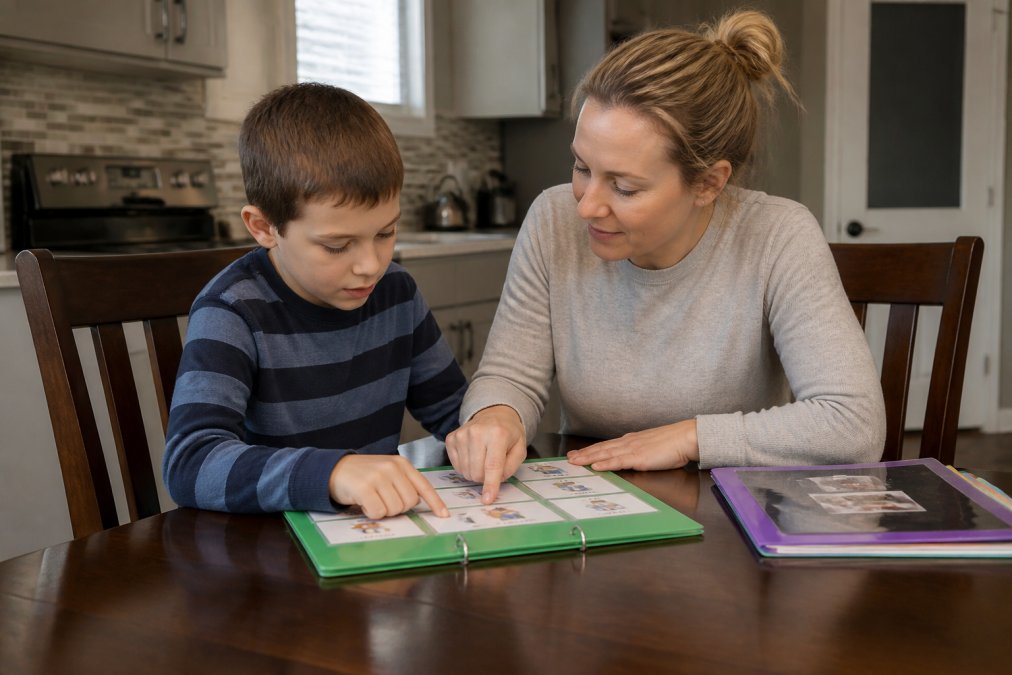
Why Routines Do the Heavy Lifting
A predictable sequence tells a child's brain what comes next, lowering the cognitive load of every transition. For a child with prenatal alcohol exposure, working memory and time perception are often the weakest links, so an external sequence does the job their brain cannot yet do alone.
Build a Routine in Five Steps
- Choose one window. Morning, after school, or bedtime. Not all three.
- Write the sequence in the child's language. "Shoes, coat, bag, door" beats "get ready for school."
- Photograph each step. Tape the photos in order at the child's eye level, bathroom mirror, bedroom door, front door.
- Practice when calm. Run the routine on a Saturday with no time pressure so the sequence becomes muscle memory.
- Re-teach after every disruption. A weekend at a relative's house, a cold, a schedule change, expect to rebuild from step one. This is normal, not regression.
The Daily Windows That Matter Most
Morning. Lay out clothes the night before, including socks. Sock seams are a common sensory trigger and a frequent cause of morning meltdowns. Keep breakfast identical for two weeks before varying it.
Transitions: The Highest-Risk Moment
Most meltdowns happen at the seam between activities, not during them. Warn at ten, five, and one minute using a visual timer the child can see, and name the next activity out loud: "Timer rings, then we brush teeth." Avoid open-ended prompts like "are you ready?", they invite negotiation the child isn't equipped to handle.
Language That Works
Keep sentences short and literal, sarcasm, idioms, and rhetorical questions all fail. "The kitchen looks like a tornado hit it" means nothing; "Put the cups in the sink" does. Give one instruction at a time and wait for completion. If you repeat an instruction more than three times, the problem is usually the instruction, not the child.
A Calm-Down Space, Not a Time-Out Chair
A calm-down corner is a regulation tool, not a punishment. Stock it with items the child chooses, weighted blanket, headphones, fidget, picture book. The child should be able to go there voluntarily before escalation, and you should model using it yourself. A time-out chair teaches that big feelings are bad; a calm-down corner teaches that they're manageable.
What to Expect in the First Month
Progress isn't linear. A routine that works for two weeks may collapse after a doctor's appointment or a sibling visit. Track what preceded the collapse, time of day, sleep, food, last transition. Patterns emerge within weeks and tell you which part of the routine needs scaffolding, not which consequence to add.
Therapeutic Parenting for FASD: Connection Over Correction
Therapeutic parenting for FASD means your relationship is the intervention. Correction without connection teaches a child they're a problem; connection first teaches them they're safe.
In practice, this looks like:
- Getting low and close before giving an instruction
- Naming the feeling before addressing the behavior
- Offering two acceptable choices instead of a demand
- Repairing after every rupture, every time
FASD Advocacy for Foster Families: School and System Navigation
FASD advocacy for foster families starts with documentation. You're often the only consistent adult tracking patterns across home, school, and appointments.
Keep a simple binder with:
- Assessment reports and diagnoses
- A one-page summary of your child's strengths and triggers
- Incident logs with dates and times
- Names and contact info for every professional involved
Educational Accommodations and School Advocacy
Educational accommodations for FASD reduce memory and organization demands, letting your child show what they know without being blocked by executive functioning gaps.
Request these in writing:
- Written instructions alongside verbal ones
- Extra time for transitions between classes
- A quiet space for regulation breaks
- Reduced homework load with modified expectations
- A designated staff member who understands FASD
Caregiver Self-Care and Building Your Support Network
Caregiver burnout isn't a character flaw, it's a predictable outcome of parenting without adequate support. FASD parenting demands more vigilance, repetition, and emotional regulation than typical parenting, and foster parents often carry that load without the lifelong relational history biological parents draw on.
Why FASD Caregiving Burns Hotter
Three factors stack up. First, the strategies that work are counterintuitive: you respond to behavior that looks like defiance as if it were a disability, every time, often in public where onlookers see only a "misbehaving" child. Second, progress is slow and non-linear, so the feedback loop that normally sustains a caregiver is missing.
Recognize Your Own Warning Signs
Burnout rarely arrives suddenly. Common early signals include:
- Dreading the sound of the child waking up
- Snapping over small things that would not have bothered you a month ago
- Skipping your own meals, medical appointments, or sleep to keep the household running
- Feeling numb rather than angry or sad
- Withdrawing from friends because explaining your situation feels exhausting
If two or more sound familiar, treat it as data, not failure, the support system needs to change, not you.
Build Support in Layers
Peer layer. A caregivers' group, in person or online, is the single most protective factor most foster parents report. The value isn't advice; it's being in a room (or thread) where no one has to explain why a nine-year-old needs a visual schedule.
Micro-Recovery That Fits Real Life
Long bubble baths aren't realistic for most foster parents. What works is smaller and more frequent:
- Ten minutes outside, alone, after the child is settled
- A standing phone call with one friend on the same day each week
- A hard stop on caregiving tasks at a set hour, even if something is unfinished
- One activity per week that has nothing to do with the child, the case, or FASD
Protect the Basics
Sleep, food, and movement aren't luxuries, they're the physiological foundation of the patience FASD parenting requires. A caregiver running on five hours of sleep can't deliver the calm, short, repetitive responses these strategies depend on. If the child's sleep is disrupted, that's a caregiving problem to solve, not a personal endurance test.
When to Ask for More Help
If you are experiencing persistent low mood, intrusive thoughts, or a sense that you cannot continue, contact your family doctor or a provincial mental health line. Asking for help is not a signal that you are failing the child. It is the same logic you apply to the child: meet the need before the crisis.
| Challenge | FASD-Informed Response | Why It Works |
|---|---|---|
| Repeated instructions ignored | One instruction, visual cue | Reduces memory load |
| Meltdowns at transitions | Visual timer, warning | Builds predictability |
| Homework battles | Modified workload | Removes executive demand |
| School resistance | Written accommodation request | Creates accountability |
| Caregiver exhaustion | Scheduled respite | Restores capacity |
Frequently Asked Questions
What are the core principles of FASD-informed care for foster parents?
FASD-informed care focuses on understanding that behaviors stem from brain differences caused by prenatal alcohol exposure, not willful defiance. Key principles include using visual routines, giving one instruction at a time, maintaining a calm environment, and reframing meltdowns as signs of sensory or emotional overload. It also means building a supportive team and advocating for your child's needs at home, at school, and within the child welfare system.
What specific parenting strategies work best for children with FASD?
FASD parenting strategies that work include breaking tasks into small steps with visual cues, using consistent daily routines, offering choices within safe limits, and reducing sensory triggers like loud noises or bright lights. Therapeutic parenting for FASD prioritizes connection over correction, so when a child is overwhelmed, comfort first and teach later. These approaches help improve behavioral regulation and reduce caregiver burnout over time.
How can foster parents advocate for FASD-informed support within the child welfare system?
FASD advocacy for foster families starts with documenting your child's specific needs and how FASD affects their daily functioning. Request a formal assessment if one hasn't been done, and ask for training on FASD-informed care for anyone involved in your child's case. Connect with organizations that provide advocacy training and peer support. You can also ask for educational accommodations through the school and push for placement stability by sharing your child's triggers and successful strategies with caseworkers.
What is the difference between traditional parenting and FASD-informed care?
Traditional parenting often relies on consequences and rewards to shape behavior, assuming a child can link cause and effect. FASD-informed care recognizes that prenatal alcohol exposure can affect executive functioning, memory, and sensory processing, so standard discipline may not work. Instead, FASD-informed care uses predictable routines, visual supports, and a trauma-informed practice lens. It also prioritizes building a supportive environment that reduces stress for both the child and the caregiver.
Parenting a child with FASD can feel isolating, especially when extended family or schools don't understand the diagnosis. You don't have to figure this out alone. Harrison's Hope offers caregiver groups, one-on-one consultations, and advocacy training built by people with both professional expertise and lived experience. Get started with Harrison's Hope and find the practical tools, community, and compassion your family deserves.